The Business of Offshore CO₂ Storage: A New Market for Maritime Infrastructure
Copyright VectorMine/AdobeStock
Carbon capture and storage (CCS) is moving from a collection of demonstration projects toward a new infrastructure business. As of July 2025, 734 commercial CCS facilities were in operation or development, up from 628 a year earlier, while total capture capacity in the pipeline increased from 416 million tons per annum (Mtpa) to 513 Mtpa (64 Mtpa operational) (Figure 1).

Figure 1. Cumulative operating CCS facilities by region, 1972-2025
Source: Intelatus Global Partners’ interpretation of Global CCS Institute data.
The number of operating facilities rose from 50 to 77 between 2024 and 2025, while 657 facilities were in different development stages in 2025 (Figure 2).
 Figure 2. CCS facilities project pipeline, year-on-year change, 2024-2025
Source: Intelatus Global Partners’ interpretation of Global CCS Institute data.
Commercially, this matters because more projects are moving from studies toward physical assets, contracted services, and long-duration operations.
Growth Is Shifting Toward Offshore-Capable Regions
An independent Intelatus Global Partners review identifies eight operating facilities and seven facilities under construction involving offshore CO₂ injection for geological storage or enhanced oil recovery (EOR), as of 2025.
Europe is emerging as a leading market for shared networks and offshore storage development – its dedicated CO₂ transport-and-storage projects doubled between 2023 and 2024. To the East, in Asia, CNOOC commissioned China’s first offshore CCUS project at the Enping 15-1 oilfield in 2025. The project is expected to inject more than 1 Mt of CO₂ over the following decade for EOR while increasing crude-oil production by around 200,000 tons. To the West, in the Americas, Petrobras’ Santos Basin pre-salt project provides an established offshore precedent, reinjecting 14.2 Mt of CO₂ into the basin’s pre-salt reservoirs in 2024, capturing EOR-associated CO₂.
Together, these developments show a strong fit between CCS growth and the existing offshore energy ecosystem. But for maritime and offshore companies, the opportunity lies less in capture equipment than in what happens after capture.
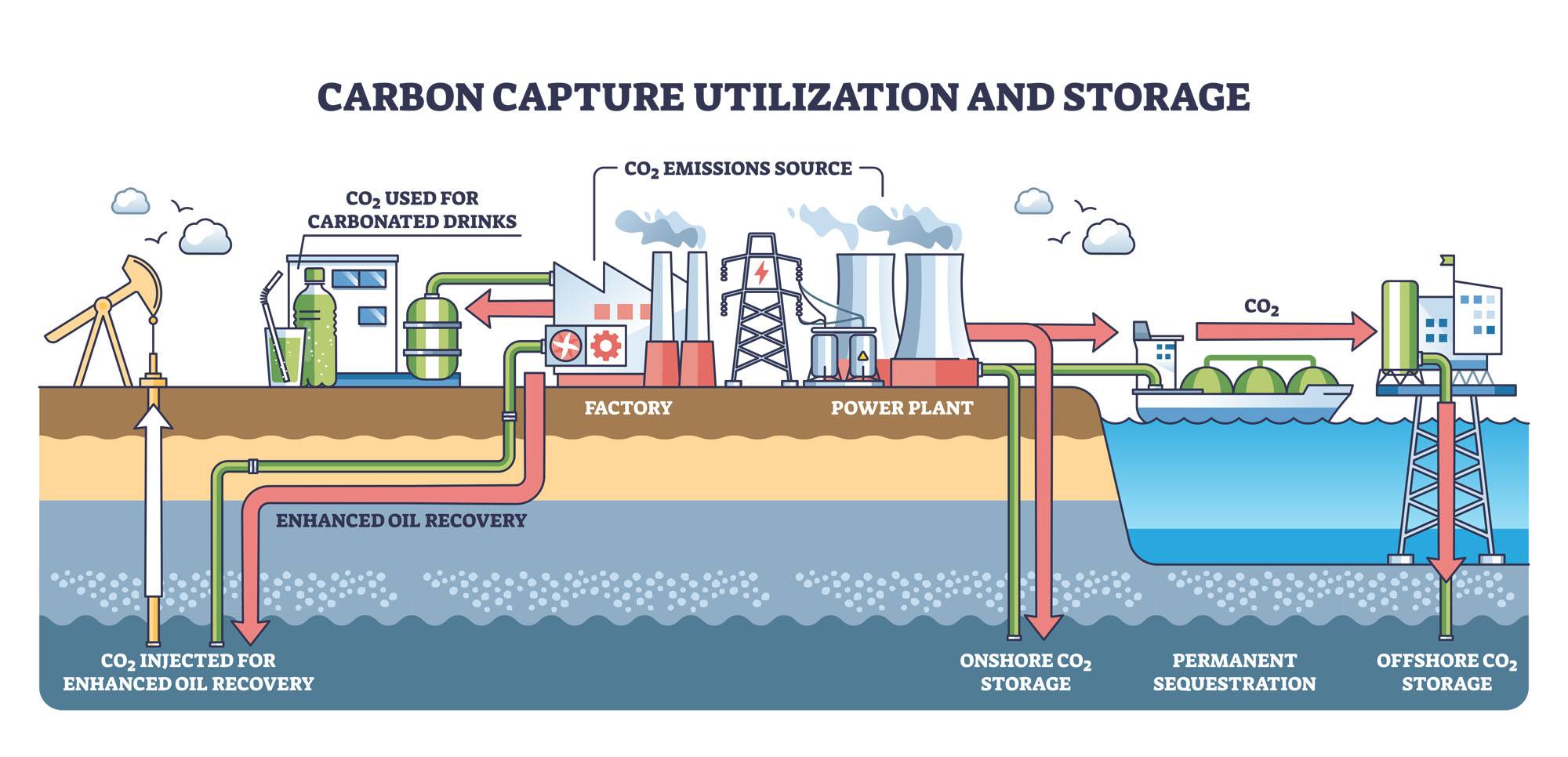
Depending on the transport mode, CO₂ must be dehydrated and compressed for dense-phase pipeline transport, or liquefied, refrigerated, and stored for marine transport. It then requires receiving, injection, monitoring, and long-term stewardship arrangements. As storage shifts offshore, ships, ports, pipelines, wells, platforms, and subsea systems connect industrial emitters with the reservoir, creating a new offshore value chain and potentially a new commodity flow.
Offshore Storage Models Are Diversifying
Storage geology shapes the business model. Depleted oil and gas reservoirs benefit from existing subsurface data on pressure, porosity, and permeability and may allow wells or pipelines to be reused. Saline formations offer larger potential resources but usually require more appraisal and new infrastructure. The former can lower development uncertainty and capital needs; the latter can support larger dedicated storage hubs.
Table 1. Selected offshore CO₂ storage developments
| Project | Region | Annual capacity | Offshore model |
| Northern Lights | Norway | 1.5 Mtpa (to at least 5 Mtpa) | Ship-to-terminal, subsea pipeline to offshore saline reservoir |
| Porthos | Netherlands | 2.5 Mtpa | Pipeline, reused offshore platform/wells and depleted gas fields |
| Greensand Future | Denmark | 0.4 Mtpa (potentially 4-8 Mtpa) | Dedicated CO₂ carrier to offshore platform and depleted oil field |
| Northern Endurance Partnership | United Kingdom | 4.0 Mtpa (potentially 10-23 Mtpa) | Offshore pipelines to saline aquifer; all-subsea injection system |
| Liverpool Bay CCS | United Kingdom | 4.5 Mtpa (potentially 10 Mtpa) | Repurposed offshore gas infrastructure and depleted fields |
| Kasawari CCS | Malaysia | 3.7 Mtpa | Integrated offshore gas-field CCS with storage in a depleted reservoir |
Sources: Northern Lights; Porthos; Greensand Future / INEOS; bp / Northern Endurance Partnership; Eni; PETRONAS; IEA.
Northern Lights achieved first injection in August 2025, receiving liquefied CO₂ at Øygarden by ship and sending it through a 100-kilometer pipeline into the Aurora reservoir around 2,600 meters below the seabed in the Norwegian North Sea. The project demonstrates a commercial model in which ships deliver CO2 from multiple industrial customers to a common coastal terminal and offshore storage system.
Greensand Future takes a different route – CO₂ is aggregated at the Port of Esbjerg and shipped to the Nini field in the Danish North Sea. The vessel acts as a virtual pipeline for emitters outside a fixed network. Pipelines concentrate spending upfront in fixed assets, while shipping carries more operating costs through liquefaction, fuel, storage, and cargo handling. That makes ships more flexible as volumes and destinations are evolving, while pipelines are better suited to large, predictable flows.
Eni’s Liverpool Bay system repurposes parts of existing offshore infrastructure and depleted gas reservoirs around 30 kilometers offshore. For mature basins, CCS can therefore extend the economic role of reservoirs, wells, and pipelines after hydrocarbon production declines.
In the Northern Endurance Partnership project, CO₂ from Teesside and the Humber industrial cluster will move through two offshore pipelines to the Endurance saline aquifer, where all installed infrastructure will be subsea, including manifolds, flowlines, and six injection wells.
Porthos has advanced construction of its onshore and offshore transport system and well-conversion program, but in April 2026 pushed start-up to no earlier than the second half of 2027. This demonstrates that while reuse reduces greenfield requirements, it does not remove integration risk.
Kasawari in Malaysia provides yet another model – CCS integrated directly with offshore gas production. PETRONAS plans to capture CO₂ from the high-CO₂ Kasawari gas field offshore Sarawak and reinject around 76 Mt over the project life.
A New Offshore Commodity
The legal framework is also becoming more workable. The London Protocol, the 1996 IMO treaty governing disposal of wastes and other materials at sea, adopted a 2009 amendment permitting cross-border export of CO₂ for sub-seabed storage; in 2019, parties approved provisional application before formal entry into force. That matters because the best storage sites may lie in a different country from the emissions source.
Transporting CO₂ also requires a different physical chain from conventional bulk shipping. Pipeline systems typically compress CO₂ into a dense phase, while marine transport requires liquefaction and refrigerated storage before loading. That means the maritime opportunity extends beyond the vessel itself to compression and liquefaction systems, storage tanks, pumps, loading equipment, and terminal infrastructure.
Ports can therefore become carbon hubs. CO₂ from multiple capture sites can be consolidated at coastal terminals for conditioning, temporary storage, and onward transport. Ports serving refinery, chemical, cement, and power clusters are natural aggregation points.
When Sharing Becomes Good Business
This supports a hub-and-cluster model in which several emitters share transport and storage infrastructure. For lower-volume sources such as individual cement plants, a dedicated pipeline and storage system may be uneconomic – aggregation can therefore expand the addressable CCS market, not merely reduce unit costs.
Maritime industry players should pay attention to the development of terminals aggregating volumes, CO₂ carriers connecting dispersed sources, and storage systems serving multiple customers. Transport and storage can become a standalone infrastructure business based on contracted capacity and long-term service agreements. Northern Lights already follows this model, offering third-party emitters across Europe access to an integrated transport-and-storage network.
Policy Is Creating Storage Demand
The European Union (EU) Net-Zero Industry Act requires developing at least 50 Mtpa of annual CO₂ injection capacity in the EU by 2030. In May 2025, the European Commission identified 44 obligated entities expected to contribute to that target. This shifts the CCS discussion from whether storage capacity should be developed to how quickly it can be permitted, financed, and connected to emitters.
That raises the strategic value of offshore expertise. Oil and gas companies bring reservoir models, seismic data, well inventories, and operating systems while contractors contribute drilling, subsea engineering, compression, flow assurance, and integrity capabilities. Ports and shipowners connect dispersed capture sites with concentrated offshore storage.
The Main Risk Is the Chain
Porthos illustrates a key CCS risk – all parts of the system must come online together. Delays in pipelines, compression, wells, capture facilities, or permitting can leave completed assets underused and postpone revenues across the whole project. This type of integration risk is familiar across many maritime and offshore projects.
However, unlike oil or LNG, captured CO₂ usually has little or no intrinsic sale value at destination in dedicated-storage chains. Revenues instead come from transport-and-storage fees, carbon-price incentives, regulated support, or the compliance value created for the emitter. CO₂ used for EOR or other applications can generate additional revenue, but this is not the core business model for most dedicated storage hubs.
Storage is also a long-duration service, with obligations extending from site characterization through monitoring, post-injection surveillance, and eventual closure. Because operators recover costs through transport and storage services rather than the sale of a commodity, asset utilization and contracted throughput are critical to project economics. Anchor customers, long-term contracts and shared infrastructure therefore become central to project finance.
The Next Offshore Market
Carbon sequestration is creating a new infrastructure market rather than simply adding another piece of equipment to industrial plants. The value chain reaches from ports and specialized ships to subsea pipelines, repurposed platforms, injection wells, reservoir management, and decades of monitoring.
Not all CCS spending will move offshore, but the direction is clear – as the market scales, a growing share of the commercial opportunity extends beyond capture into transport and dependable, permitted storage. For maritime and offshore companies, CO₂ is becoming a new cargo, a new subsurface service and a new use for aging infrastructure.