Nepal places climate justice in the centre of its global appeal for flood relief
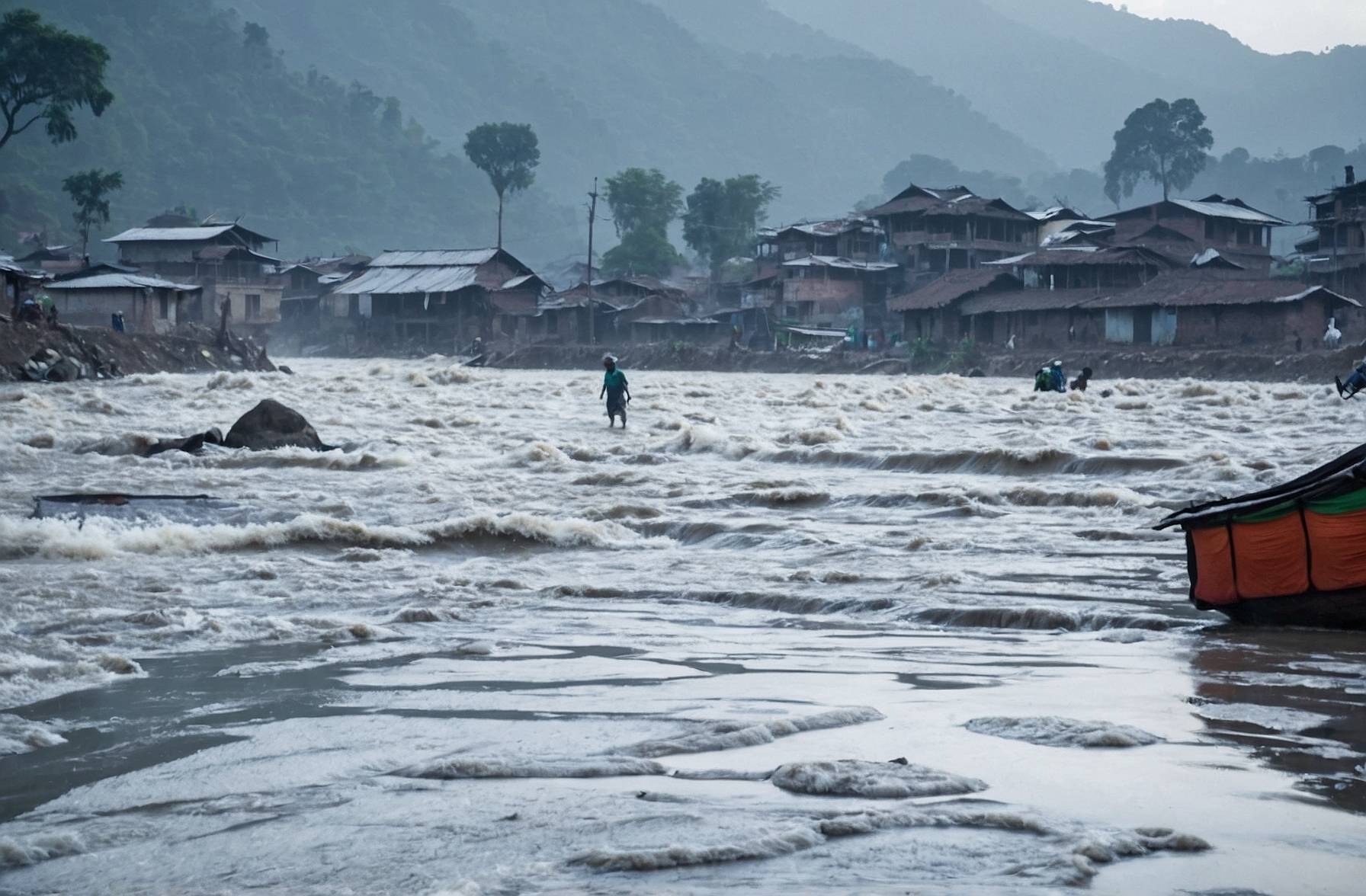
Officials said that Nepalese officials will be asking wealthy countries and international agencies for financial assistance this week. They claim they should "contribute" to the $5 billion required for initial reconstruction, as the disaster shows climate change's impact on 'poor' countries.
Since the collapse of the Himalayan Glacier in late August, which caused destruction in the valleys below it, more than 5,300 people are still missing in Nepal and China’s Tibet region.
In Nepal, the torrent washed away 12 hydropower stations, as well as roads, bridges and houses.
Dharam Raj Uprety, Nepal's Disaster Management Chief, said that Nepal's first estimate of funds will cover the first phase?of recovery in the next five month and it will be shared with World Bank and Asian Development Bank as well as the embassies and consulates of other countries and groups, including the United States, Britain and India, China and Japan, and the European Union.
"It is not just a flood-induced disaster, it's a massive one. He said that climate change was the cause of a disaster.
This week, the UN is reporting on Nepal's plan for the first-time to make its $5 billion reconstruction need a climate justice concern in its outreach to donor countries and agencies.
Climate Change Impact: A Shared Responsibility
Officials in Nepal have publicly described the disaster as a prime example of "the disproportionate impact" of climate change upon "poor countries".
Nepal expects international agencies and partners to "recognise and take responsibility on this type of event", although it is not the country's role to dictate how much should be contributed, said Prakash Pokhrel. A geologist with the National Disaster Risk Reduction and Management Authority.
Pokhrel stated, "We don't need to say what causes climate change. You already know the reasons why it is occurring and who contributes most to this."
"Countries such as Nepal do not contribute to climate change in a significant way, yet they face this level of disaster. Why should the responsibility not be shared by all of humanity?
China is responsible for about a third (or more) of the global emissions. The United States, and Nepal's neighbour India are also major emitters. Nepal's submissions to UN have stated that Nepal's contribution to greenhouse gas emissions in the past and present is negligible.
TYPICALLY, FUNDS COME SLOWLY
The experience of Pakistan, a country in South Asia, shows that funding for natural disasters is often slow and can lag behind initial commitments.
After devastating floods in 2022 that caused millions to be displaced, Pakistan received about $11 billion from international partners. These included the Islamic Development Bank and Saudi Arabia. Nearly 42% of these commitments, or $4.6 billion, was used by international partners to import oil instead of directly repairing flood damage.
In early 2024, it was estimated that only $3.4 million had been actually disbursed. The oil funding was $1.45 billion of the total amount disbursed.
Officials said that the Nepal government was 'finalising' a report on the extent of damage and losses, and the?funding needs for temporary shelters and schools, and other essential infrastructure.
The donor outreach comes ahead of Prime Minister Balendra Shah’s speech at the United Nations, scheduled for September 24. He is expected to ask for greater international support in developing countries that are vulnerable to climate change.
(source: Reuters)


